
GROUP EVENTS
Practical Tools, Real-time Change, Fun With Like-Minded People
STAGE PRESENCE WORKSHOP
Learn to stay calm and present when all eyes are on you
About this event
What is Stage Presence?
We could define it as a mix of body (posture, breath, how you occupy space), voice (pace, tone, pauses), attention (where your focus is), and inner state (how safe you feel being witnessed). The last one is the root: if the nervous system feels threatened, the body shows it, so a lot of presence work is really about regulation and feeling safe in the spotlight.
This workshop takes a different approach to stage presence. Rather than focusing on voice techniques or body language, we'll explore the connection between your body, your attention and the way you show up in front of an audience.
Speaking well has layers. There's what you say: your message and structure. There's how you deliver it: voice, gestures, movement. And underneath both, there's your presence: how connected and grounded you are while you're up there.
This workshop is about that foundation. Your body is where nerves show up first, and it's also the one place you can reach in the moment. You can't order your mind to calm down, but you can feel your feet on the floor. When you learn to stay with your body while you speak, your breath steadies, your attention frees up, and everything else you've learned about speaking has room to work.
This is stage presence from the inside out. Whether you're a seasoned Toastmaster or you just want to present better at work, you're welcome here. No experience needed.
It's a skill that can be trained, and it varies with context, so someone can have great presence one-on-one and lose it in front of a crowd.
When we picture a great speaker, we think of words: a clear message, a good structure. But the audience gets the speaker's body first. They see the shoulders, the breath, the eyes, the stillness or the fidgeting, and they feel your state before you say a single sentence.
And when nerves hit, the body is where it starts: breath gets shallow, shoulders rise, the voice tightens, and your attention leaves the room and goes into your head. That's why "just relax" and "just be confident" don't work. You can't think your way out of a body reaction, but you can learn to stay with your body while it happens.
This workshop is about stage presence from the inside out: staying grounded, feeling your nerves without being run by them, and putting your attention on what you say and who you say it to. Toastmaster or not, you're welcome here. No experience needed.
Who is this for?
Leaders who present to teams and stakeholders. Business owners who pitch. Toastmasters who want to go deeper. Professionals who want to feel steadier in front of people. No experience needed.
WHAT WE WILL DO
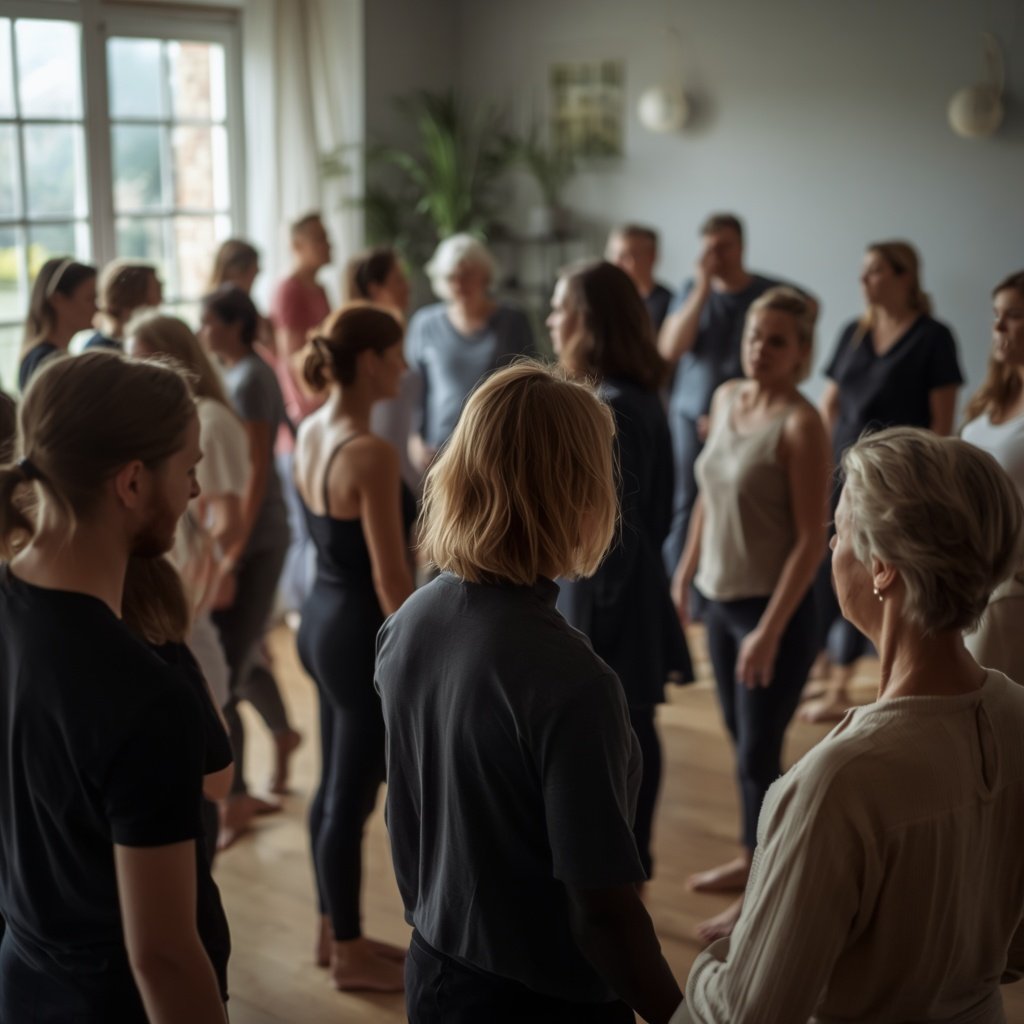
You'll build a skill, not collect tips. In two hours, you'll train your attention to stay anchored in your body, first on its own, then while talking, then under real pressure, and then in front of the group, where it counts.
You'll also work with your own stage fears and learn what your nervous system is doing when they hit, so you can steady yourself in real time. It's hands-on from start to finish, in a small group where everyone is practicing alongside you.
Through practical exercises, you'll experiment with slowing down, becoming more aware of your body, staying connected to yourself while interacting with others, and maintaining that connection when speaking in front of a group. We'll also look at what happens when nerves and fears kick in, and how to work with them rather than letting them take over.
WHAT YOU WILL LEARN
One concrete technique [name it here] for staying present in your body while you speak, which you can use on stage, in a pitch, or in a meeting, in real time
A short routine to ground yourself before any talk
A way to calm your nervous system in the moment, not just before or after
A clear picture of your own fears when speaking, and how to use them as signals instead of obstacles
The experience of having done it, with your body, in front of people
or
Practical ways to stay grounded and connected to your body while speaking.
Ways to recognise and work with common speaking fears, such as going blank, not knowing an answer or running out of time.
An opportunity to experiment with speaking in front of others in a supportive environment.
FAQs
What should I wear?
Comfortable clothes that allow light movement and sitting on the floor. Layers are helpful.
Do I need to bring anything?
A bottle of water if you wish. We'll provide tea and snacks.
Can I arrive later?
No. To maintain group focus and safety, doors will close at 19:00 sharp. Please be on time.
Is there parking nearby?
Yes. Free street parking is available near the venue.
Can I cancel my ticket?
Yes, up to 24h before the event. The tickets cannot be cancelled/refunded in less than 24h before the event, also not if you show up too late and can't enter.
Do you have any other questions? Please send me a message here: oana.hypnotherapy@gmail.com
PRACTICALITIES
Duration:
Date:
Time: (Walk-in from )
Language: English
Cost: €55.00 (free for ETBC Members)
Facilitator: Oana Serbana
Location: Studio Yol-Kat
Please note:
To have a smooth start, doors close at 16:00 and we won’t be able to reopen them after that. Thank you for respecting the group by being on time.
Stage Presence: Find Your Ground
What is stage presence?
Stage presence is more than having a strong voice, confident posture or good body language. It's also about how connected you are to yourself when you're in front of an audience.
What's this workshop about?
We'll explore stage presence from a body-awareness perspective. Rather than working on voice techniques or body language, we'll focus on how to stay connected to your body and grounded in the moment, even when your attention is pulled towards the audience, your thoughts or your nerves.
What will we do?
Through practical exercises, you'll experiment with body awareness, attention and connection while walking, interacting with others and speaking. We'll also explore common speaking fears, understand what's happening when nerves kick in, and practise ways to work with them in real time.
What will you leave with?
A clearer understanding of how body awareness contributes to stage presence.
A practical way to stay connected to your body while speaking.
Ways to recognize and work with fears such as going blank, not knowing an answer or running out of time.
First-hand experience of what it feels like to speak while staying grounded and present.
Is this for you?
Whether you regularly speak in front of groups, facilitate workshops, pitch your business or simply want to feel more present when all eyes are on you, this workshop is an opportunity to experiment and practise. No previous speaking experience is needed, just an openness to try something different.
Here is a landing page draft designed to position your workshop clearly—warm, direct, free of empty motivational clichés, and honest about its specific niche so the right people sign up.
Stage Presence Through the Body
A hands-on workshop on staying grounded, calm, and present when you speak.
What this is about
Most public speaking and stage presence workshops focus on the outside: how to project your voice, where to put your hands, or how to structure a pitch.
This workshop takes a different route. We don’t coach gestures, vocal tricks, or polished "body language." Instead, we work from the inside out—training your connection to your own body while you speak.
When you step in front of a room, adrenaline naturally pulls all your attention into your head. You start overthinking, rushing, losing your train of thought, or disconnecting from the people listening to you. By learning how to anchor part of your awareness back into your physical body in real time, you regulate your nervous system, stay steady under pressure, and hold a room without having to "perform" confidence.
Who this is for
This is for you if:
You speak in front of groups—whether on stage, in meetings, teaching, or pitching—and want to feel less trapped in your head.
You’ve tried standard speaking tips, but they feel stiff or go out the window the moment nerves kick in.
You want a practical, physical way to handle common speaking fears (like going blank, running out of time, or losing your composure) in the moment.
You’re open to experiential, slightly unconventional exercises rather than sitting and taking notes.
This is probably not for you if:
You’re looking for a traditional public speaking course on slide design, storytelling frameworks, or vocal coaching.
You prefer a passive lecture over active physical and partner exercises.
What we will do
Instead of theorizing about presence, you’ll spend most of the session testing how your attention and nervous system actually behave under pressure:
Sensory & somatic warm-ups: Slow, focused exercises (from how you walk to how you eat) designed to pull your attention out of your head and into physical sensation.
Split-attention speaking: Partner conversations and short improv speaking rounds where you practice holding a thought and talking while keeping an anchor in your body.
Discomfort & focus training: Physical endurance exercises that train you to stay connected to your purpose—and your body—even when things feel uncomfortable.
Working with fear in real time: Identifying your specific speaking triggers (like going blank or feeling rushed) and learning how to read them as useful cues rather than panic signals.
Grounded visualization: A closing mental rehearsal to lock in the physical feeling of standing in front of a large crowd while staying completely steady.
What you’ll walk away with
A practical anchor for speaking: A concrete technique to keep part of your awareness in your body while talking, so you don't spiral into overthinking.
Real-time nervous system regulation: An understanding of what happens physically when stage nerves hit, and how to settle yourself down mid-sentence.
A healthier relationship with speaking fears: Practical ways to handle going blank, running out of time, or not knowing an answer without freezing up.
Presence without the act: The ability to hold attention simply by being settled and genuinely there—no forced posture or rehearsed gestures required.
Tips for your webpage layout:
Add a quick "Practical Details" box right next to or below the intro (Date, Time, Location, Group Size—mentioning a small group size actually helps sell experiential workshops like this because it builds safety).
Button / CTA copy: Instead of a generic "Sign Up," use something low-friction and direct like "Reserve your spot" or "Join the session."
All those mechanics—posture, eye contact, pacing, projection—are just the hardware. You can execute every single one of them flawlessly and still look like a well-programmed robot.
The actual presence—the thing that makes it real instead of a performance of confidence—comes down to three specific psychological and neurological mechanisms happening underneath the mechanics:
1. Radical Attention (Outward vs. Inward Focus)
The single biggest killer of presence is self-monitoring—the internal loop of "How do I look right now? Did I hit that note? Do they like me?" The moment your attention turns inward, a subtle physical disconnection happens: your eyes glaze slightly, your timing lags by milliseconds, and your micro-expressions freeze.
Real presence happens when 100% of your cognitive bandwidth is aimed outward—locked onto the room, your scene partner, the lyric you are currently singing, or the exact reaction of the person in the third row.
You cannot be self-conscious and fully observant at the same time.
When you are genuinely observing the audience (not just performing at them), they feel seen. That mutual awareness creates an immediate, electric sense of "being in the same room together."
2. Micro-Alignment (Congruence)
Humans are extraordinarily good at detecting incongruence—when someone’s body says one thing and their voice or words say another. If you adopt a "power stance" while internally panicking, the audience sees a stiff person trying to look confident.
Presence feels real when your internal state, your intention, and your physical output are completely aligned:
You aren't pretending to feel something; you are actually generating the thought in real time. If you say a line or sing a lyric for the 500th time, you have to re-think the thought as you say it, rather than playing back a memorized recording.
When your face, breath, posture, and tone all emerge from the exact same real-time impulse, the audience’s nervous system registers total honesty. That honesty is what we call "authenticity."
3. High Stakes and Present-Moment Risk
Think about why a tightrope walker has effortless stage presence without doing any "charisma tricks." They are completely inside the present moment because the stakes are real right now.
Recorded media is safe and predictable; live performance is dangerous because anything can happen. Many performers try to eliminate that risk by over-rehearsing every gesture until it is locked in amber. Ironically, that kills presence.
Real presence requires staying live to the moment—willing to adapt your tempo to the room's energy, willing to hold a silence until it feels slightly uncomfortable, or willing to let a genuine emotion crack your voice rather than smoothing it over.
When an audience senses that what is happening on stage is happening for the first time right now—and couldn't be replicated the exact same way tomorrow—they cannot look away.
How the Mechanics and "The Realness" Connect
You master the physical mechanics (posture, breath, stillness, eye control) not to fake presence, but to remove the static.
Nervousness, slouching, rushing, and fidgeting act like interference on a radio signal. Training the mechanics clears the channel so that when you lock your attention outward and commit to the moment, nothing gets in the way of the audience receiving it.
Stripped of all mystique, "stage presence" is simply visual, acoustic, and behavioral control. When an audience feels drawn to someone, their brains are responding to concrete, trainable signals—posture, eye mechanics, timing, and muscular tension.
The tangible, mechanical elements you can isolate, practice, and master break down into five core areas:
1. Posture and Center of Gravity
Audiences subconsciously assess competence within milliseconds based on how a body handles gravity.
Grounded Stance: Weight distributed evenly across both feet (roughly shoulder-width apart), knees unlocked. Shifting weight nervously from hip to hip or crossing ankles signals instability and leaks authority.
Spinal Alignment & Chest Openness: Shoulders dropped down and back (not rolled forward), sternum lifted slightly. Closing off the torso—via crossed arms, clutching a mic stand with both hands, or hunching over—triggers a defensive visual cue.
Economy of Movement: Eliminating "leakage"—unconscious micro-fidgets like tapping fingers, adjusting clothing, pacing aimlessly, or swaying rhythmically when the material doesn't call for it. Every movement has a clear start, trajectory, and clean stop.
2. Eye Mechanics and Focal Control
Where a performer looks dictates where the audience looks.
Landing the Gaze: Instead of sweeping eyes across the room like a lighthouse (which makes connection impossible), lock onto one specific person for a complete thought or musical phrase (roughly 2–4 seconds), then cleanly move to another section.
Eliminating "Searching" Eyes: Looking up at the ceiling, down at the floor, or darting eyes to the side while trying to remember lines or lyrics breaks the connection immediately.
Peripheral Awareness: Keeping a soft, wide awareness of the whole room even while focusing on one spot, so you don't accidentally ignore the balcony or the far left/right edges of the stage.
3. Pacing, Silence, and Timing
Beginners rush because adrenaline distorts their perception of time; what feels like five seconds to the performer is barely one second to the audience.
Weaponized Silence: Holding stillness and silence before starting (waiting 2–3 full seconds after reaching your mark before speaking or playing) and after a major point or punchline. Silence forces the audience to lean forward.
Tempo Contrast: Deliberately altering speed. Speeding up builds urgency and excitement; slowing down signals weight, authority, and importance.
Clean Transitions: Mastering the "dead air" between songs, slides, or scenes. Knowing exactly how to move from one beat to the next without awkward mumbling, shuffling notes, or dropping energy.
4. Vocal Mechanics and Acoustic Projection
Presence requires taking up acoustic space without straining.
Breath Support: Breathing low into the diaphragm rather than shallowly into the upper chest. Shallow breathing tightens the throat, raises pitch, and makes the voice sound thin and anxious.
Resonance and Articulation: Projecting from the chest/mask rather than shouting from the throat, paired with crisp consonants so the back row doesn't have to work hard to decode words.
Dynamic Range: Using deliberate shifts between quiet intimacy and full volume. If everything is delivered at 80% volume, nothing stands out.
5. Spatial Choreography and Blocking
How you use the physical architecture of the stage.
Proximity Control: Moving closer to the edge of the stage (closing the physical gap) during intimate, conversational, or high-stakes moments, and stepping back during expansive or reflective moments.
Directional Orientation: Keeping the torso and face open to the audience ("cheating out") rather than turning sideways or showing your back, unless doing so is a deliberate, temporary theatrical choice.
Intentional Stillness: The ability to plant your feet and remain completely motionless while delivering a line or holding a note. Stillness on stage acts like a spotlight—it draws every eye in the room to the one thing that isn't moving.
6. State Regulation (Managing Adrenaline)
Stage presence collapses when physiological fight-or-flight symptoms take over.
Down-Regulating Tension: Identifying where stress hides physically (usually the jaw, shoulders, tongue, or hands) and consciously releasing those muscles before and during a performance.
Recovery Protocols: Having a pre-rehearsed physical response for mistakes—keeping your posture intact, maintaining rhythm, and never making a "mistake face" (wincing, shaking your head, or apologizing), which alerts the audience to errors they otherwise wouldn't have noticed.